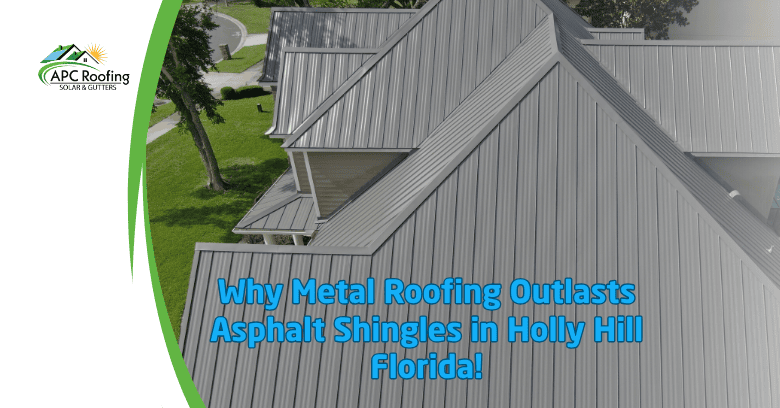
Searching for Metal Roofing Throughout Palm Coast Florida?
APC Roofing installs panel coverings and mends worn sheet, for houses as well as workshops and barns.
Call 386-356-2111 and you will hear in plain words what condition the roof is in.
Telling Systems Apart: Visible Clues
Corrugated and ribbed sheet is held down by screws driven straight through the metal, while standing seam is attached with clips tucked inside raised joints. Steel with a protective coating covers most houses that have metal, with aluminum and copper turning up less often.
A glance from a lawn at lines of screw heads points to a through-fastened roof, and uninterrupted pans separated by raised folds mean standing seam. Outbuildings and porches lean toward ribbed or corrugated sheet, and homes turn up with both.
Cross-Section Choices – Span and Style
Corrugated sheet ripples in smooth, repeating curves, while ribbed designs show angular ribs and wide flats. Side by side, adjoining lengths overlap by one crest, and a printed fastening schedule sets where screws land.
A squared profile resists bending and reaches further between purlins, and a rounded wave appeals on older or rustic structures. On a big roof plane, taller ribs keep a downpour from spilling over side laps, while modest runs need little depth.
Fasteners in the Open – Why Installation Matters
Each screw clamps a panel down onto wood or steel framing, while a washer at each head keeps rain from following a shank. Years of sun and heat stiffen synthetic rubber until cracks form, well ahead of the painted steel nearby.
An overdriven screw squashes a washer flat, while an underdriven or tilted fastener never seals all the way around.
Fresh Fasteners – Benefits and Gaps
Rubber rings across a ribbed or corrugated field wear out together, and a full re-screw is an ordinary step somewhere along the way. Worn hardware is taken out in turn, and an oversized screw returns to every hole to catch undamaged fibers or metal.
A re-screw stops drips around screw heads and draws lifting sheets back down, but corrosion, parted laps and bad flashing are left as found. Replacements are chosen for whatever framing lies underneath, lumber or steel, and color-matched tops blend in with a painted finish.
Expansion and Contraction: Room to Travel
A steel panel stretches in sunshine and draws in after dark, and a long run can gain a quarter inch between noon and midnight, with aluminum going about twice as far. Metal screwed down with no give wears each hole into an oval, and washers begin to leak.
Snapping sounds at sunrise come from panels shifting against clips, and a properly detailed roof suffers no harm.
Anchoring Standing Seam: Out of the Weather
Every lengthy pan is secured firmly in only one zone, and floating clips farther along give the metal freedom to shift. Trim at an unanchored end leaves a gap for travel, and rigid fastening over a big pan shears or wrinkles the metal.
Each pan is set in place, and clips are driven through into the deck along one side, so each new pan conceals all hardware below.
Joint Styles: Choosing Between Options
A snap-together rib engages when an installer presses down, and mechanical versions are finished by a rolling tool. A double-lock seam holds far better against strong gusts and standing water, and maker approvals cover shallower slopes.
Widths between ribs and the height of each rib differ by line, and a home's design and a buyer's taste guide selection. Accessories such as clips and closures fit a single system, and a mismatch shows up as gaps and loose joints.
How Much Material Is Up There – Worth Confirming
Steel is described by gauge rather than inches, and a lower figure means more metal per sheet. Pole buildings frequently carry twenty-nine, and residential work leans on twenty-six and twenty-four.
Aluminum is called out in decimal inches, and in either metal thicker stock dents less and lies flatter. Standing in a yard, nobody can judge weight by eye, so a label or order sheet is what gets checked.
Factory Protection: Choosing a Finish
Steel for roofing is hot-dipped in zinc or an aluminum-zinc blend, and a color coat is baked on afterward. Paint scuffed but not broken through is fine, while a sheared edge or a deep gouge lets rust begin.
High-end fluoropolymer finishes keep a bright look for years, but silicone-modified polyester goes dull and powdery earlier. Wet mortar and fresh concrete attack an aluminum-zinc coating, and a separator goes wherever panels touch new brick.
Base Material: Matching a Location
Aluminum is lighter than steel and never forms red rust, but softness means a heavier grade for equal toughness. Beside salt water at the coastal end of our range, protective layers wear away faster, and makers restrict certain products near surf.
Copper turns up chiefly on bay windows, dormers and entry roofs, and the metal is left bare to weather.
Metals That React: Treated Lumber and Wrong Screws
A copper pipe or flashing above steel sends corrosive drainage down over the panels, and discoloration arrives well before a panel gives way. Treated wood touching aluminum pits the metal at each contact, and an incompatible screw causes slow damage nearby.
New flashing or trim has to match the metals already in place, or tape and membrane keep dissimilar metals from meeting.
Looks, Not Leaks – Why Installation Counts
Oil canning names shallow dips and bulges across a flat pan, and a midday sun hides what a low evening sun reveals. A slightly distorted pan sheds rain like any other, and the roof lasts no less.
Heavier gauge, narrower pans and pencil ribs in each flat all reduce waviness, and a smooth, straight base under the panels counts. Photos of finished roofs give a fair idea of how much oil canning shows, and the final pick is yours.
Everyday Comfort: What Reaches Living Space
Panels laid straight over bare purlins ring out in a downpour, since a single skin is the only barrier. On a house, a solid deck, underlayment and ceiling insulation sit below the panels, and indoors, few people notice more noise than under asphalt.
A light-colored panel sheds much of the sun's warmth, and the attic takes in far less. Dark metal heats up like any black roof on a clear day, and without venting and insulation, color alone does little. After sunset, metal sheds stored warmth quickly, so upstairs rooms settle sooner at night.
Guard Rows: Above Entries and Paths
Where winters bring real snow in our territory, slick panels shed a snowpack quickly, and an avalanche off an eave can flatten shrubs, gutters or anyone underneath. Stops attached to the metal let a load leave slowly, and typical spots are above doors, walks, decks and gas meters.
For standing seam, bolted clamps grip each upright joint, while ribbed or corrugated sheet takes mounts driven into structure with sealing washers, and at the warm end of our range snow gear is unnecessary.
What Ice Does – A Record of What Happened
Hail is common across the colder end of our territory, and panels with an impact rating are an option. A strike sharp enough to break a finish lets rust start, and a flattened rib or a shifted cap can leak.
Following a storm, our roofer takes pictures and measurements, and each dent and damaged panel is located.
Uplift: Layout Matters
Suction gathers along rakes and eaves, and air that gets under a loose edge can peel a sheet back. Trim hooks over a continuous strip fastened to the deck, and no gap is left to work into.
Fasteners go in closer together near corners and a roof's rim, set by a maker's tested layout for each exposure. Along the coastal end of our service area, hurricane risk raises fastener counts again, and only systems with a high wind rating qualify.
Vents and Stacks: Detail Work
Each pipe takes a boot made for panel roofs, with a base pressed to follow corrugations, and a flat location lets a flange bed down evenly. Larger units get a raised curb plus a cricket on an uphill side, so no water dams up.
Caulk is a secondary barrier behind formed metal, as ultraviolet light turns soft compounds brittle in a few seasons.
Where Slopes Meet: Built to Drain
A valley pan goes down ahead of any panel, and sheets are cut on a diagonal to suit. Exposed ends are bent back and gripped by cleats, and fasteners stay clear of wherever rain concentrates.
Where a long run needs more than one length, a lap is sealed between layers, and screws pass through both thicknesses, upper over lower.
Limits Near Flat – When a Membrane Wins
Through-fastened sheet generally wants about three inches of rise per foot, and at anything less, rain creeps sideways across laps toward screws. Standing seam with double-locked joints goes much lower, with some lines cleared almost down to flat.
A barely tilted roof over a porch or addition is common on houses, and we measure pitch on site, and where metal does not belong, a membrane does.
Under Everything – Out of Sight Once Done
On a house, the panels go over solid sheathing, and a synthetic barrier made for high heat sits on top, because old felt bakes and sticks under hot steel. Farm buildings frequently carry metal over bare purlins, and support distance dictates grade.
Once an old covering comes off, spongy sheathing is found and swapped, because screws in decay have nothing to grip.
Going Over the Existing Roof: Condition Decides
Where code allows, metal can be installed over one layer of shingles, so waste is kept out of a landfill. New steel adds well under two pounds per square foot, so rafters rarely need reinforcing. A synthetic underlayment and rows of battens come next, and every fastener is sized to reach solid wood.
A roof that was recovered once before, or a deck with decay underneath, comes off entirely, because moisture trapped under new metal keeps doing damage.
Perimeter Details – Fillers and Trim
Closures matching a panel shape stop up hollows under each rib at both extremes, so blown rain and critters are shut out. A ridge cap may be vented or sealed, depending on how an attic is ventilated.
Rake trim, drip edge and an apron into a gutter close off a roof's outline, and fascia boards are kept out of runoff.
Care on Site – Sheet by Sheet
A seamed panel comes off a forming machine cut to the length of a run, so no crosswise joint sits in the path of runoff. An extended panel needs enough hands under the metal to stay straight, and a pan that gets bent should not go on the roof.
On panels, a step belongs in a flat above a purlin or deck, because a raised joint dents and deforms under load. A damp or dew-covered pan gives a shoe nothing to hold, so owners do better keeping off the roof.
Signs Worth a Call: Without Climbing Up
- Orange halos at fasteners, on a slope facing afternoon sun.
- Screws backed out of holes, on a south exposure.
- Flashing flapping in a breeze, following a gusty night.
- A collar gapping around a stack, close to a ridge.
- Rust creeping from a trimmed end, at the bottom of a run.
- Color gone patchy, on a south exposure.
- A drip that follows a row of screws, under a porch roof.
- A joint gaping open, near a valley.
How APC Roofing Approaches Metal Roofing in Palm Coast Florida: Our Routine
Our starting point is pinning down which system is up there and how the panels are secured, followed by every screw or clip, edge, boot, valley and lap. Thickness, coating and hardware style go into notes, and from inside, the attic shows any old leaks.
What we find goes into a report with photographs, and a reason sits beside every recommendation. When a small fix works, nobody pushes a bigger job, and a roof past saving is described plainly.
Metal Roofing Around Palm Coast Florida – Careful Assessments
Reach us at 386-356-2111 and a visit gets put on the calendar.
Fix or Redo: Piece by Piece
A lone bad pan can be taken out and exchanged, although new paint never quite matches older metal. Replacing a cracked boot deals with water at a pipe, while re-fastening cures aged washers.
When corrosion has gone through across a whole field, a tear-off is due, and a covering failing at nearly every joint is in the same position. Redoing one face of the house is a middle path, when damage stays in one place.
Aging Gracefully – Upkeep Matters
A carefully installed panel system can pass forty years, and every estimate is approximate. Standing seam, with no holes through a pan, gets by on less maintenance, whereas exposed-fastener sheet needs a re-screw partway through.
Copper runoff, bare edges and caulked joints where flashing belongs shorten the life of a roof, and a check every few years catches small faults early. Leaves and twigs that collect against a curb or in a valley hold moisture against coated steel, so removal pays off in longer-lasting paint.
When you are weighing Metal Roofing in Palm Coast Florida, call APC Roofing at 386-356-2111. We will inspect all hardware, every edge and each penetration, and a written report puts options in front of you.
Verified

Verified
Verified
Verified