Plenty of Florida homes were built without gutters, so you may not have thought about them until now. Then the summer storms start, and you notice the bare strip of soil along the drip line, the mud splashed up the stucco and the puddle that forms at the front door every afternoon. Rain gutters in Palm Coast fix that by catching the water at the roof edge and putting it somewhere it can’t do harm.
Maybe you’re not sure gutters are worth it, or you’ve heard they’re more trouble than they’re worth. That’s a fair question to ask before spending money. You deserve an honest answer about your own house, not a sales pitch.
APC Roofing has installed roofs and rain gutters since 2017. We’re GAF Certified, licensed in Florida (CCC1337030) and insured, and your estimate is free.
Does a Palm Coast home really need rain gutters?
Not every house does. A home with wide overhangs, ground that slopes away on all sides and nothing but lawn under the roof edge can get by. Most homes have at least a few spots where gutters earn their keep:
- Doorways and walkways. Water pouring off the roof right where you walk in.
- Landscaping beds. Heavy runoff digs trenches, splashes mulch around and drowns plants along the drip line.
- Stucco and siding. Splash-back leaves dirt and staining along the bottom of the wall, and keeps that area damp.
- The foundation. Water that pools against the slab, day after day, isn’t something you want around any house.
- Fascia and soffits. Water that runs over or behind the roof edge soaks the wood trim and leads to rot.
Coastal Florida’s sandy soil washes out fast under a steady stream of roof runoff. Summer storms bring a lot of rain in a short time, and hurricane season, June 1 through November 30, can bring days of it. A good gutter system moves all that water to a few chosen spots and away from the house.
Choosing rain gutters in Palm Coast
Material
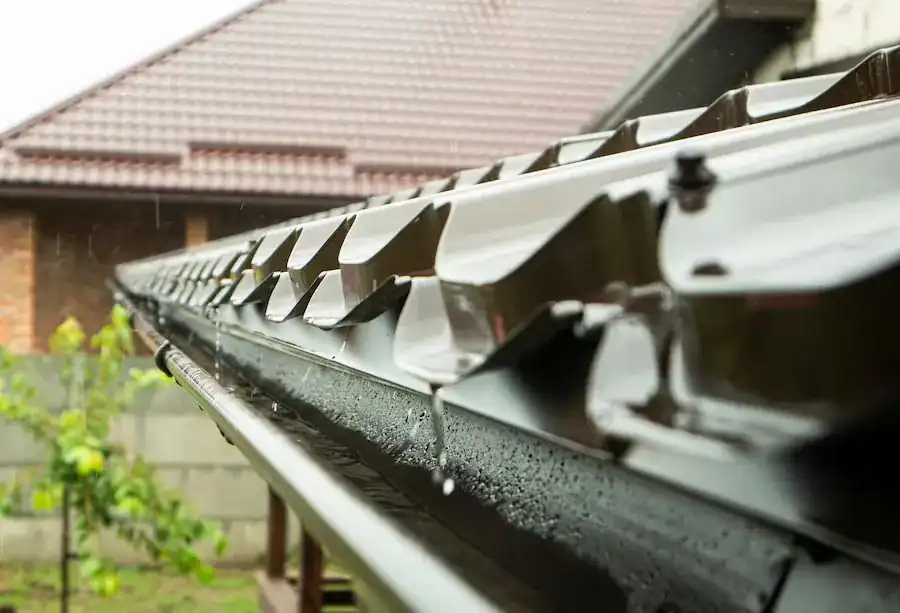
Aluminum is the usual choice in Palm Coast. It won’t rust in salt air, it’s light enough to hang securely on most fascia, and it comes in a wide range of colors. Steel can rust near the coast once its coating wears, and vinyl tends to get brittle and sag in years of strong sun.
One-piece vs. sectional
Sectional gutters come in pre-cut lengths that get joined together on the house. Every joint is a spot that can leak as the sealant ages. Many homeowners prefer gutters formed on site from a coil of aluminum, so each run along the front of the house is a single piece with joints only at the corners. Fewer joints means fewer places to drip.
Size and shape
K-style gutters, with a flat back and a decorative front, are the most common on homes here. They hold more water than rounded half-round gutters of the same width. Five-inch gutters fit many homes, while larger or steeper roofs often need six-inch gutters and bigger downspouts to keep up with a downpour. Our gutter installation in Palm Coast page explains how the sizing works.
Color
Gutters usually match the fascia or trim so they blend in, or the roof color so they read as part of the roofline. Bring it up during your estimate and you’ll see the options.
Where the water ends up
A gutter is only as good as its downspouts. Each one should empty onto a splash block or an extension that carries water several feet from the foundation, out toward the yard or a spot that drains well. If water still collects next to the house, the gutters haven’t solved the problem.
Keeping rain gutters working
Gutters need a little attention to keep doing their job. Check them after big storms and a couple of times a year, more often if trees hang over the roof. Signs of trouble you can see from the yard:
- Water spilling over the front edge in a moderate rain
- A run that sags or has pulled away from the fascia
- Peeling paint or soft spots on the fascia behind the gutter
- Stains or wet soil right below a corner
If you notice any of these, give us a call and we’ll take a look.
How it works
- Book your free estimate. Call 386-259-8425 or request a free online estimate.
- Get a clear, honest assessment and estimate. We look at where water goes now, measure the roof and check the fascia, then give you a written estimate with the size, material, color and downspout layout spelled out. Financing is available through Aqua Finance, Fortifi, Hearth and Home Run Finance.
- Your gutters go up and the site gets cleaned up. The crew installs and tests the system and leaves the yard clean.
Runoff damage builds slowly, which makes it easy to ignore. A season of storms can wash out a flower bed and soak a stretch of fascia that later needs replacing.
Rain gutter questions from Palm Coast homeowners
Do I need gutters in Florida?
Many homes benefit from them, especially over doorways, patios, landscaping beds and anywhere water splashes against the wall or pools by the foundation. Some homes with wide overhangs and good grading can do without. An estimate visit will tell you which spots on your house need them.
Are one-piece gutters better than sectional gutters?
For most homes, yes. With fewer joints, there are fewer places for leaks to start as the sealant ages.
How often should I clean my gutters?
At least twice a year, and after major storms. If trees hang over your roof, check them more often.
Will rain gutters hold up to hurricane winds?
Securely fastened aluminum gutters handle strong wind far better than loose ones, but no gutter is storm-proof in a direct hit. If a storm damages your gutters or roof, you file the insurance claim and pay your deductible; we document the damage, provide an estimate and work with your adjuster.
Talk to a Palm Coast gutter installer
Call 386-259-8425 for your free estimate, or start online. After the next summer storm, the water goes where it should: a dry front step, a flower bed that stays put and walls that stay clean. You can also see everything we do in your area on our Palm Coast roofing page, or browse our Palm Coast gutter services.